Showing posts with label Wildflowers. Show all posts

Friday, August 7, 2009

Diaspora


Diaspora is a Greek word meaning the scattering of seeds. We are now heading into late summer and plants are setting seed. One of the things I most enjoy at this time of year is marveling at the variety of forms produced by seed bearing plants.

Seeds hold an embryo and carry the genetic material of a new plant. There are three methods evolved by plants to disperse their seeds-by wind, by water, and by animals.

The structures used by plants to get their seeds aloft and carried by the air currents of the earth are masterpieces of engineering. The designs include gliders, parachutes, whirlybirds, and spinners. Gliding seeds are said to have inspired the designs of some early aircraft. I like to think that spinner or whirlybird seeds may have contributed to one of Leonardo Da Vinci's concepts for a flying machine.

An outstanding example of the parachute design is the ubiquitous Common Dandelion (Taraxacum officinale) a member of the Composite family. The seed (achene) is attached by a thin stalk to a radiating plume of bristly hairs (pappus). So equipped, the seeds become airborne in response to the slightest breeze. As is often the case with parachuting seeds, they are arranged in a globular puff. Another name for the dandelion is blowball. The word pappus is Latin for old man.

The Composite family includes sunflowers, daisies, coneflowers, chicory, and thistles. In members of this family, the pappus is modified in a multitude of ways, often to promote the effective dissemination of seeds. For example, in sticktights, the pappus is barbed so that it adheres to passing animals. The characteristic of the pappus is important in identifying the particular species of a Composite blossom.

In his last years, Thoreau was working on an exhaustive research project to determine all of the dominant patterns of seed dispersal within an hour's walk of his home in Concord, Massachusetts. He called it "learning the language of the fields." Thoreau was one of the first American field ecologists to apply Darwin's ideas of natural selection to the subject.

Thoreau died from a respiratory infection before he could finish his manuscript entitled The Dispersion of Seeds. The work is an argument against the then-prevalent theory that some plants grew spontaneously without any root, seed, or cutting from a parent plant. Typically, Thoreau combines keen observation with a view to a larger perspective. His description of the milkweed ends with these thoughts :

I am interested in the fate or success of every such venture which the autumn sends forth. And for this end these silken streamers have been perfecting themselves all summer, snugly packed in this light chest, as perfect adaptations to this end--a prophecy not only of the fall, but of future springs...Who could believe in prophecies...that the world would end this summer, while one milkweed with faith matured its seeds?

Alphabet Bloggers

Wednesday, July 22, 2009

Alien Invaders

Alien species, non-native species, exotic species. These are plants, animals or other organisms that have been abruptly (compared to natural migrations) introduced to an ecosystem, usually by human doings-often accidentally, but sometimes intentionally. This phenomenon has caused dramatic changes worldwide, and continues to do so.

I recently learned that many of our most familiar "wild" flowers are non-native and have been around for centuries. Seeds hitched across the Big Pond with early European immigrants. Each summer I'm happy to see the 6 foot tall flowering spikes of fuzzy leaved Common Mullein that stand at attention like soldiers reviewing a parade. What country girl hasn't picked a bouquet of Queen Anne's Lace and marvelled at its umbrella of tiny white florets?

These roadside weeds are rather benign, but for an example of negative effects, one word: kudzu. A noxious vine, kudzu strangles and smothers everything in its path. It was aggressively planted by the U.S. government in the 1930's for erosion control before it was discovered that in our humid southern states it grows just too well.

European starlings (Sternus vulgaris) were brought to North America by a man who wanted to seed our continent with all the birds that are mentioned in Shakepeare! The descendants of the original 75-100 birds released in New York's Central Park in the 1890's now number more than 200 million. Starlings have voracious appetites, migrate in flocks of up to 100,000 birds, and have contributed to the decline of the bluebird, purple martin and tree swallow.

Not all non-native species are home wreckers, but those that are earn another moniker: invasive, although this term is passing out of favor in ecological circles. (Truth be told, a native species may be invasive as well, meaning it rapidly colonizes an area, such as the Maryland state flower, the Black-eyed Susan. )

By any name, an exotic invasive species does not "smell" sweet-- but through no fault of its own really. In its homeland, it probably evolved to be in relative harmony with its surroundings. But transplanted to a new environment, it may have few or no natural predators, no competing species, and other species may have no natural resistance to it. The result is imbalance and perhaps irrevocable degradation of indigenous flora or fauna.

Since species are interdependent, when one species goes it can take others with it in a chain reaction. This dynamic has severely impacted the vulnerable islands of Hawaii. Seventy three percent of U.S. extinctions have occurred in Hawaii. Feral goats, pigs and sheep are some of the worst offenders there.

We learned how wolves benefitted the ecosystem when they were eradicated (by homo sapiens) from places like Yellowstone. Without wolves, elk proliferated and began overgrazing vegetation, which in turn affected other species, increased erosion, and impaired water quality. The ecosystem there is now mending due to the much publicized, and controversial, re-establishment of wild and free wolves.

Growing to 60 feet, the American Chestnut was formerly a dominant tree throughout our eastern forests, until a blight hit it early in the 20th century. The culprit? -- a variety of chestnut brought here from Asia that had resistance to the blight. Scientists are working to develop resistant strains of our native tree in hopes of restoring the chestnut to its former place as king of the forest. Doing so could have a substantial impact on mitigating climate change.

It is sobering when I consider not only changes I've witnessed in a half century of outdoor wanderings, but just recently. This past spring I saw infestations of garlic mustard in shady glens along the Potomac, choking out trillium, mayapples (see photo left), jacks in the pulpit, and other delicate native wildflowers that were flourishing only a few springs ago.

From my childhood, I remembered the path at Cunningham Falls State Park as a magical tunnel formed by the delicately needled branches of eastern hemlock trees. Wanting to get an early start on sharing my love of nature with my grandson, I took him there when he was only one year old. The magic remained. While perhaps not as plentiful, the hemlock branches still drooped gracefully above us like tiers of shyly lowered eyelashes. My grandson is now almost five years old. On a recent solitary visit, I felt like a survivor on a battlefield. The skeletons of eastern hemlock trees littered the forest floor or stood gray and silent like ghosts.

In this heavily used park, where biodiversity has already been severely diminished by grazing white-tailed deer, I suspect the hemlocks may have been even less resistant to the Wooly Adelgid-an introduced aphid-like pest. To add insult to injury, Japanese Stilt Grass was making rapid headway in crowding out native Lady ferns. (Where's Waldo the fern?) The overall effect was one of barren sterility.


Young families walked past me as I stood shell-shocked. They were blissfully unaware of what they had missed. But I knew, and mourned their loss. Especially on behalf of the children.

At my feet, a huge black beetle scurried at a surprising pace across the path to avoid being trampled. He frantically pulled some leaf litter over his head and body, obscuring not only himself but his own vision. Although tempted, I didn't disturb him. I knew how he felt.

ABC Wednesday

Tuesday, July 7, 2009

Endless Variations on a Theme


As my perceptions become more acute on this journey into nature, I am more and more in awe of the endless variety of plant shapes and patterns of growth and how/why they evolved. For example, I attempted to "key" out a huge white flowering "weed" found near the C&O Canal towpath near Harper's Ferry, WV this spring. Using the Newcomb's Guide to Wildflowers, I wasn't having much luck, until I realized the plant's resemblance to Queen Anne's Lace (an alien import). I broke off a leaf, crumbled it, sniffed it, even tasted it! Yep, that carroty scent. (Queen Anne's Lace is known as a wild carrot.) This led me to the right page in the book.
The plant was in the parsley family-a common species known as Cow Parsley (Anthriscus sylvestris) a native to Europe, Africa and Asia, that often grows to over six feet. Since Newcomb's Guide uses a keying method that is based on numbers of petals and leaves and their arrangement, I decided to count the stems in the umbel, and came up with 29. That seemed wierd, so I counted again. And again. Still 29. That brought up the question: what is the "math" behind nature's botanical design?
I had heard about Fibonacci numbers but had never studied them. Fibonacci was a mathematician in the Middle Ages. The numbers emerged as he studied the reproduction patterns of rabbits! The numbers are an infinite series, beginning with the numeral 1, where each successive number is the sum of the two numbers that appear directly before it. Design based on these proportions approximates the "golden ratio," also known as the golden mean, golden number or divine ratio. Expressed as a decimal, the golden ratio is approximately 1.6 , referred to as Phi.
Growth patterns that follow the golden ratio are rampant in nature. Two examples often cited are the spirals of a nautilus shell and seed head of a sunflower. The golden ratio is seen as well in the proportions of the human body--even the structure of DNA is a demonstration of the golden ratio. Not surprising that in classic art and architecture, the golden ratio was considered to be the foundation of beauty.
But back to Cow Parsley. The number 29 was not listed in the Fibonacci series of numbers. But there is another series that models the golden ratio, developed by Lucas, the mathematician who "discovered" Fibonacci's work. This series of numbers is also very prevalent in the growth patterns of plants. The Lucas series replicates the "sum of the previous two numbers" feature, but starts with 2 followed by 1. And there it was, my Cow Parsley's "29." Amazing what trying to identify a weed can lead to....! Now I see the golden ratio everywhere, as in the thistle bud at top.

Wednesday, May 20, 2009

To Be Born

Have you ever seen a just-born child? The small figure is luminous--so infused with the energy of becoming that the outlines of his or her body appear to waver like a mirage. Even the most cynical of us can't help but be awed. The word miracle rises to the lips.

I had a similar experience on a dragonfly foray with a naturalist friend last Saturday.
We were at a low water bridge on the Cacapon River in Morgan County, West Virginia. It was one of those days in May that foretell the heat and humidity of July. We seemed to have entered a giant incubation chamber, for life was hatching all around us.

Cool water from weeks of spring rain flowed between banks of freshly leaved trees, newly sprouted grasses, and wildflowers budding or in bloom. The sun's rays danced through the air, setting all things green ashimmer.

Tiger and zebra swallow-tailed butterflies flitted in small clouds and flocked to sip at puddles. Their wings looked impossibly fragile. Not a tatter or speck of dust marred the patterns of creamy yellow, pale celadon and inky black. A drop of columbine red punctuated the base of each wing like the dot of a exclamation mark.

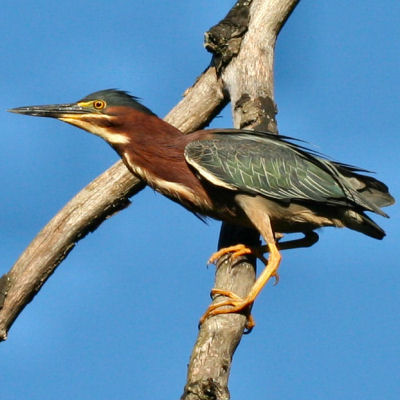
A green heron with a watchful eye rimmed in gold perched motionless on a snag midstream. Flashing scarlet helmets and bars of black and white, two male red-bellied woodpeckers alighted at the base of a sycamore. They hesitated, artfully askew on the pale trunk. I imagined them as bright enameled jewelry adorning the breast of a 1940's screen siren.

Dragonflies had recently passed through their metamorphosis from aquatic larvae to airborne adults. They cruised the river's edge like miniature hovercraft. Each was escorted, in perfect formation, by the image of a watery twin.

Low to the ground, tiny native bees meandered here and there to gather nectar. A brown water snake slithered through the shallows. All the while, the insistent murmur of American toads played as background music.

My friend snared an Applachian Jewelwing damselfly with her net. It was an immature male--still only half dressed in its armor of emerald green. She gently folded its wings to meet above the thorax and passed it to me. The finely veined gossamer was slightly damp and clung to my fingers.

The word nature descends from the Latin nasci "to be born." Capturing bits of data is often the goal of observation in the field. There is a special excitement as another piece of a giant puzzle slips into place. But what I most enjoy is seeing the world as if revealed for the first time. Deep in my bones, I sense the truth of how all of us--plants, insects, animals, humans--are made of the same stuff. We are born from the same mother. My heart flutters as I whisper a single word: miracle.