Tuesday, July 7, 2009

Endless Variations on a Theme


As my perceptions become more acute on this journey into nature, I am more and more in awe of the endless variety of plant shapes and patterns of growth and how/why they evolved. For example, I attempted to "key" out a huge white flowering "weed" found near the C&O Canal towpath near Harper's Ferry, WV this spring. Using the Newcomb's Guide to Wildflowers, I wasn't having much luck, until I realized the plant's resemblance to Queen Anne's Lace (an alien import). I broke off a leaf, crumbled it, sniffed it, even tasted it! Yep, that carroty scent. (Queen Anne's Lace is known as a wild carrot.) This led me to the right page in the book.
The plant was in the parsley family-a common species known as Cow Parsley (Anthriscus sylvestris) a native to Europe, Africa and Asia, that often grows to over six feet. Since Newcomb's Guide uses a keying method that is based on numbers of petals and leaves and their arrangement, I decided to count the stems in the umbel, and came up with 29. That seemed wierd, so I counted again. And again. Still 29. That brought up the question: what is the "math" behind nature's botanical design?
I had heard about Fibonacci numbers but had never studied them. Fibonacci was a mathematician in the Middle Ages. The numbers emerged as he studied the reproduction patterns of rabbits! The numbers are an infinite series, beginning with the numeral 1, where each successive number is the sum of the two numbers that appear directly before it. Design based on these proportions approximates the "golden ratio," also known as the golden mean, golden number or divine ratio. Expressed as a decimal, the golden ratio is approximately 1.6 , referred to as Phi.
Growth patterns that follow the golden ratio are rampant in nature. Two examples often cited are the spirals of a nautilus shell and seed head of a sunflower. The golden ratio is seen as well in the proportions of the human body--even the structure of DNA is a demonstration of the golden ratio. Not surprising that in classic art and architecture, the golden ratio was considered to be the foundation of beauty.
But back to Cow Parsley. The number 29 was not listed in the Fibonacci series of numbers. But there is another series that models the golden ratio, developed by Lucas, the mathematician who "discovered" Fibonacci's work. This series of numbers is also very prevalent in the growth patterns of plants. The Lucas series replicates the "sum of the previous two numbers" feature, but starts with 2 followed by 1. And there it was, my Cow Parsley's "29." Amazing what trying to identify a weed can lead to....! Now I see the golden ratio everywhere, as in the thistle bud at top.

Monday, June 22, 2009

Solstice Bounty

On solstice Sunday I set off to do some errands and meander country roads. Before I went a half mile, I saw these bumble bees (probably Bombus impatiens according to my bee consultant) and a lone male Monarch Butterfly (Danaus plexippus) feasting on nectar in a patch of Common Milkweed (Asclepias syriaca). Later, at the entry to the hardware store, I feasted my eyes on flats of annuals, blazing in every color. On my way home, sweet local cherries at a roadside stand made for another kind of feast! It occurs to me that we have insects to thank for so much beauty and bounty in our world.
Our native pollinators like bumblebees, solitary bees, flies, wasps, beetles, butterflies and moths are important to the production of many crops, including sweet cherries. All grasses, many trees and other plants depend on the wind to distribute pollen. But up to a third of the foods that make up our diet depend on insects for pollination including apples, almonds, blueberries, broccoli, cucumbers, peaches, soybeans, strawberries, kiwis, melons, onions, pears, plums and squash. More than half of the fats and oils in our diet owe a debt to insect pollinators.
Certain bats and birds also go after the nectar in flowers, and by doing so, spread pollen. But insects far outdo them. The annual value of the services of native pollinators to U.S. agriculture is estimated between $4.1 and $6.7 billion. Flowering plants provide food not only for humans, but also for animals that in turn provide us with milk or meat. Without our wild pollinators, it is questionable whether humans could survive. Entire ecosystems rest on the relationship between plants and pollinators.
How flowers and insects co-evolved is a fascinating subject. Those plants that depend on wind for pollen dissemination must produce vastly more pollen than those plants that have helpers in the process. Plants have developed colorful blossoms, enticing scents, alluring shapes, and graphic markings to attract these helpers. For example, orchids are famous for their mimicry of female insects of a variety of species. They are able to lure male insects by their odor and appearance. Some plants are pollinated only by one particular species of insect. For example, Darwin predicted that the Comet Orchid of Madagascar, with a deep, seemingly inaccessible nectar source, would have an insect pollinator adapted to reach it. And eventually that insect was identified: a moth with a proboscis that unfurled to awesome proportions.
Biologists tell us that worldwide pollinator populations are waning at an alarming rate. Here in the U.S. more than 50 pollinator species are listed as threatened or endangered. They suffer from the loss and fragmentation of pollinator habitat and the overuse of pesticides.
It would be impossible to replace all the services of native pollinators with those of managed bees. Colonies of bumblebees and honeybees are used commercially in agriculture but are increasingly threatened by disease. Escapees may be spreading disease to native bees.
Anyone who owns property, has a tiny backyard garden, or even a balcony can assist in maintaining habitat -- food, water, shelter and nesting materials--for native pollinators.
When I learned about the importance of native pollinators it underscored how every part of nature is connected to everything else. Now I know that each scrubby pasture, overgrown roadside, or weedy vacant lot is not unproductive. It is home and pantry to multitudes of tiny lives that are crucial to our own existence.

Friday, June 19, 2009

Deceive and Perceive

One type of animal camouflage is known as cryptic coloration. The colors of the animal mimic its habitat to fool the eye of predators or prey. Matching patterns of dark and light in order to blend in with the natural play of shadows, lines and textures in the environment is a highly effective strategy. Predator and prey have co-evolved in their abilities to perceive and deceive one another.

This young black rat snake Elaphe obsoleta obsoleta was coiled on the back of a wrought iron chair in the gazebo of our rented house in Great Cacapon WV this past weekend. My daughter entered to set the table for our evening meal and had quite a surprise. The snake makes a nice addition to the floral design, don't you think? However, my son-in-law removed the snake before we sat down to eat. I would imagine humans' ability to see snakes despite their attempt to camouflage themselves would be an important evolutionary advantage!

A childhood experience that made a big impression on me was the late summer evening when my father asked who wanted to accompany him on the short drive down to our small pumphouse. My younger sister and brother eagerly jumped up to go with him, but uncharacteristically for me, I hung back, preferring to stay on the porch with my mother. When my father returned he had a story for us. While my siblings had fumbled at opening the heavy car door, my father started toward the pumphouse. Directly in front of him were two stumpy mottled sticks lying across the path. Just before stepping on them, he realized what they were--a pair of copperhead snakes out for their evening hunt, or perhaps mating, but now attempting to camouflage themselves in the waning light. My father pointed out in a serious tone that if I had joined them on the errand, I may have jumped out more quickly than my siblings and encountered the snakes before he did. I believe this was the first time I grasped the meaning of the word "fate."

I don't remember if my father killed those particular snakes, but we frequently encountered copperheads, black snakes, and tiny ringneck snakes when I was growing up in Maryland. Sometimes the poisonous copperheads and even the larger of the nonvenomous black snakes (often 5 or 6 feet long) were slain if they encroached near our mountainside home. Mostly they seemed to stay in the nether region of overgrown briars and poison ivy between the driveway and the public road.

Our German Shepherd "Rinnie" would kill a snake by repeatedly grasping it in his mouth,violently shaking it from side to side, then flinging it away through the air.. He seemed able to avoid its jaws by this method. One time however, he was bitten on his paw by a copperhead. I remember pleading with my father to take him to the veterinarian as Rinnie began to show the effects of the venom. I rode along to the doctor's office in the back seat of our car with the dog's head cradled in my lap. Rinnie survived to hunt copperheads another day.

Despite the presence of these creatures, my siblings and I ran freely around the meadows and woods of our country property. For a while my older sister kept a milk snake in what I remember as a tall finely crafted wooden case with glass windows and a hinged door that latched with a metal clasp.

The local folk lore said that black snakes were a good thing to have around your house-they kept copperheads away. I don't know if this true. I do know they make pleasant pets, except for the problem of feeding them live prey. It would have been nostalgic to have caught the little rat snake for the enjoyment and study of my 4 year old grandson (and my own), if only I still had that beautiful wooden case. I do prefer to leave wild things wild and study them in their natural habitat.

The other photo is a Fowler's Toad Bufo fowleri seen at Eidolon Nature Preserve. It blended in perfectly with the leaf litter. My eye and camera snagged it only because it moved and disrupted the camouflage pattern. B. fowleri uses its earth toned skin to elude predators such as birds and small mammals. Like other toads, it can also release a foul liquid from the 'warts' on its back to irritate a predator's mouth. Another survival tactic it might use is to play opossum-it will lie belly up as if dead.

The genius of crytic coloration is the cuttlefish, a relative of the squid and octopus. It has special cells in its body that can change in color, pattern and texture almost instantly to mimic the variety of surfaces it encounters on the sea floor, allowing it to merge seamlessly with its surroundings. It has a very complex brain in order to control the up to 20 million cells that produce these optical illusions.

Wednesday, June 10, 2009

Friendly Ferns

Herbert Durand's Field Book of Common Ferns, 1928 opens with:

To All Who Follow the Long Brown Path

Here are fifty fascinating ferns of the wild, whose ancestry antedates Adam by unnumbered eons, and whose myriads of fair and friendly children await your coming in every field and every forest, by every stream and on every mountain. Their ways are truly ways of pleasantness and the path to their dwelling place is a path of perfect peace. May this unpretentious Field Book of Ferns spur you to follow this path with eyes opened to the exquisite beauty that greets you on every hand

These friendly children greet visitors to Eidolon Nature Preserve in Morgan County, WV.
Clockwise from top left: Common Polypody, Ebony Spleenwort, Sensitive Fern, Bracken Fern, Rock with Southern Lady Fern. Durand writes that Spleenworts were so named due to the belief in their ability to treat diseases of the spleen, and that Common Polypody was a favorite remedy for the 'blues' and for 'fearsome and troublesome' dreams and nightmares. I call these ferns 'heavenly.'

Wednesday, May 20, 2009

To Be Born

Have you ever seen a just-born child? The small figure is luminous--so infused with the energy of becoming that the outlines of his or her body appear to waver like a mirage. Even the most cynical of us can't help but be awed. The word miracle rises to the lips.

I had a similar experience on a dragonfly foray with a naturalist friend last Saturday.
We were at a low water bridge on the Cacapon River in Morgan County, West Virginia. It was one of those days in May that foretell the heat and humidity of July. We seemed to have entered a giant incubation chamber, for life was hatching all around us.

Cool water from weeks of spring rain flowed between banks of freshly leaved trees, newly sprouted grasses, and wildflowers budding or in bloom. The sun's rays danced through the air, setting all things green ashimmer.

Tiger and zebra swallow-tailed butterflies flitted in small clouds and flocked to sip at puddles. Their wings looked impossibly fragile. Not a tatter or speck of dust marred the patterns of creamy yellow, pale celadon and inky black. A drop of columbine red punctuated the base of each wing like the dot of a exclamation mark.

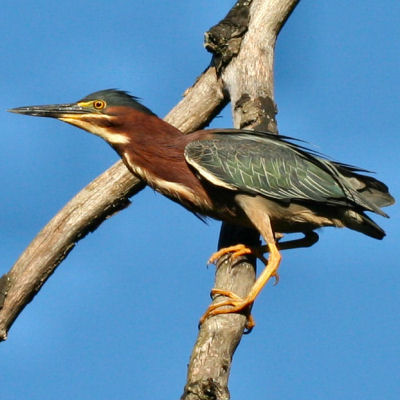
A green heron with a watchful eye rimmed in gold perched motionless on a snag midstream. Flashing scarlet helmets and bars of black and white, two male red-bellied woodpeckers alighted at the base of a sycamore. They hesitated, artfully askew on the pale trunk. I imagined them as bright enameled jewelry adorning the breast of a 1940's screen siren.

Dragonflies had recently passed through their metamorphosis from aquatic larvae to airborne adults. They cruised the river's edge like miniature hovercraft. Each was escorted, in perfect formation, by the image of a watery twin.

Low to the ground, tiny native bees meandered here and there to gather nectar. A brown water snake slithered through the shallows. All the while, the insistent murmur of American toads played as background music.

My friend snared an Applachian Jewelwing damselfly with her net. It was an immature male--still only half dressed in its armor of emerald green. She gently folded its wings to meet above the thorax and passed it to me. The finely veined gossamer was slightly damp and clung to my fingers.

The word nature descends from the Latin nasci "to be born." Capturing bits of data is often the goal of observation in the field. There is a special excitement as another piece of a giant puzzle slips into place. But what I most enjoy is seeing the world as if revealed for the first time. Deep in my bones, I sense the truth of how all of us--plants, insects, animals, humans--are made of the same stuff. We are born from the same mother. My heart flutters as I whisper a single word: miracle.

Tuesday, April 28, 2009

A Goose with a View

While poking around in the woods next to the C & O Canal towpath for a good photo of Virginia Bluebells, I disturbed this Canada Goose (branta canadensis). He was immediately on the alert, honking in a threatening way, and eyeing me with suspicion. Movement above by his mate drew my eye to the top of the old railway support.


The female goose peered over the edge of the concrete to see what the ruckus was about but didn't move from her spot. I guessed she was nesting on the top of the structure.


The goslings are going to have quite a drop when they are ready to venture forth. But you have to admire this mama's ambitious choice of site. The eggs should be well protected from skunks or raccoons. However, crows and ravens also consider goose eggs a tasty tidbit--might the eggs be more exposed in this spot? Once the goslings leave the nest, (if they survive the drop) the Potomac is a short stumble down a bank and they will be waterborne.


Typically the female Canada goose chooses the nesting site, builds the nest and lays the eggs, while the male defends the territory from other animals including other geese. Isolated spots with good visibility are preferred. Despite being trailside, this pair's nest is over 10 miles down the towpath from Williamsport, with a grand view of the river and any cyclists or nosy amateur naturalists approaching from either direction.

Canada goose nests are not elaborate and are rather quickly thrown together: weeds, twigs, pine needles, grass or moss are assembled in a mound then rounded out and molded into shape by the goose's body as she nestles in. The average clutch has five eggs but might include up to nine. It would have been fun to watch the nest building process at this spot.

Canada geese are monogamous and most pairs mate for life. Life spans can range to over twenty years. I wonder if this pair has successfully nested here before. If so, do the other geese recognize that they have "dibs" on this site? Or perhaps they are upwardly mobile newly-weds producing their first brood. They remind me of the red-tailed hawks who famously nested high above New York's Central Park adjacent to Woody Allen's penthouse--with their very own 'deluxe apartment in the sky.'

Saturday, April 4, 2009

Up Close and Personal with a Jumping Spider


Nature is everywhere if you only look. I took a brief walk in the city park at lunch. This spider was hanging out on the garden gate next to the museum. A baby spider was rappeling down from the lock on a strand of silk. The spider here was perhaps the doting mama.

Jumping spiders (Family Salticidae) are easily distinguished from other spiders by their four big eyes on the face and four smaller eyes on top of the head. Around the world there are probably more than 5000 species of jumping spiders.
I leaned in close for a better look. Instead of trying to hide, the spider turned to look directly up at me. I could see its eyes and furry whiskers. It appeared as interested in me as I was in it. Our eyes locked. Here is what I saw.

I had never felt "seen" by a spider before. I felt disoriented as if the tiny world of the spider had suddenly expanded and I had shrunk to the spider's size. It seemed some sort of communication passed between us.

The spider's behavior made sense when I later learned that jumping spiders have much better eyesight than other spiders and most, if not all, insects. Jumping spiders' large pair of eyes in the center front give them excellent color vision and a high degree of resolution. Even more amazing, the shape of their retinae indicates they may have telephoto vision. I was looking at a hunter with some high tech equipment!

Jumping spiders can spot and stalk insects from long distances. Their excellent vision is also an important part of their 'interspecies' communication, particularly in courtship. Males dance before females, displaying contrasting or brightly colored markings on their bodies.

The caption for the photo of one jumping spider that I found on the 'web' said that it lived in the space between the photographer's gate and fence post in his back yard. And here was "my" spider frequenting the same "habitat." Imagine all the humans who walk through this gate, oblivious to the ferocious sentry on watch!

When I returned to my office and sat down at my desk, a baby jumping spider about a third the size of mom appeared in my lap. It must have hitched a ride on my pants' leg while I was transfixed by its parent's gaze. Somehow even a spider baby is cute. I attempted to slide it onto a post-it note but it sprang onto my thumb. I released the baby out of my window to fall onto the grass below. It had traveled in my car with me and was now several blocks away from the park. Happy hunting, little spidey!